Cat Breeds in Egypt: The Common Ones and What Each Needs to Eat
احسب كمية أكل قطتك اليومية بالجرام
Cats in Egypt are not one kind, and the differences go beyond looks. Face shape, coat length and activity level change the portion, the kibble shape and even the bowl. Here are the breeds you actually meet here, what each one is like, and what each really needs to eat.
The Persian (with the Himalayan and the Chinchilla)
The most commonly kept cat in Egyptian homes.
One thing first
The Himalayan and the Chinchilla are not separate breeds; they are colour lines of the Persian. Everything below applies to all of them.
Temperament
Calm, happy indoors and in limited space, and clearly less active than most.
A flat face changes how it eats
A short jaw makes it hard to pick up large round kibble, so the cat licks and pushes instead of biting. Smaller kibble and a wide, shallow bowl make more difference here than anything else.
Long coat and hairballs
It swallows a lot of hair while grooming. Fibre in the food helps the hair pass, but it is no substitute for daily brushing.
Less food than you would guess
Lower activity plus neutering means fewer calories. Work out the amount by weight: the cat calorie calculator
Watch for
The folds around the nose and the tear staining need daily cleaning, and inherited kidney problems are more common in this line — so water available at all times is not a luxury.
The Egyptian Baladi
The most common cat here and the least written about.
Temperament
Adapted to our climate, more resistant to disease, and with far fewer inherited problems than imported breeds.
What it needs
Balanced, without complications. Good dry food with suitable animal protein is entirely enough.
Watch for
Many baladi cats are adopted with chronic malnutrition behind them. The improvement shows in the coat and the energy within one to two months of regular feeding — do not rush it with large portions at the start.
And the Egyptian Mau
An internationally recognised breed that comes from here: spotted, athletic, and the fastest of domestic cats. Its energy runs higher than the ordinary baladi, so its requirement runs slightly higher too.
The British Shorthair
The heavy, calm one.
Temperament
Relatively lazy, happy to sit, and will not ask for exercise on its own.
What it needs
The breed most prone to obesity after neutering. Here, controlling the portion matters more than the food itself: weigh a meal once on a scale, then use the cup whose weight you now know.
Watch for
It is naturally broad and muscular, so an ideal weight does not mean a thin cat. The test is that you can feel the ribs easily without seeing them.
The Scottish Fold
The folded ear has a price.
Temperament
Calm, sociable and much loved.
What you need to know
The fold is caused by a mutation that affects cartilage throughout the body, not only in the ear. That means the possibility of joint problems for life.
What it needs
Weight control here is a necessity, not an option: every extra kilo is carried by a joint that is already compromised. And food is not a joint treatment — follow it up with your vet.
The Siamese and the Oriental
The slim, active one that talks a lot.
Temperament
High energy, curious, and strikingly attached to its person.
What it needs
Its activity means more calories relative to its weight than, say, a British Shorthair, and it does better on small frequent meals than on two large ones.
Watch for
Dental and gum problems are more common than average, so check its mouth from time to time.
Rules that apply to every cat, whatever the breed
These are not breed details; this is what cats are.
A cat is an obligate carnivore
Unlike a dog. Taurine is an amino acid that must reach her ready-made from animal protein, and a shortage affects the heart and the eyes. Any balanced cat food has this covered, but dog food is not a substitute for cat food, not even for a day.
A cat drinks little by nature
Her ancestors were desert animals that took water from their prey. With dry food, water must be available, nearby and changed daily — and ideally in a bowl set a little away from the food.
After neutering the requirement drops
By roughly twenty to thirty percent. This is when obesity usually starts, so cut the portion within a month of the operation.
A wide, shallow bowl
A deep bowl makes the whiskers brush against the sides, which bothers her, so she leaves food and walks away. Many people read that as "he isn't eating".
Growth food until one year
Then a gradual move to adult food over seven days, like any change of food.
Our brands, made in Egypt
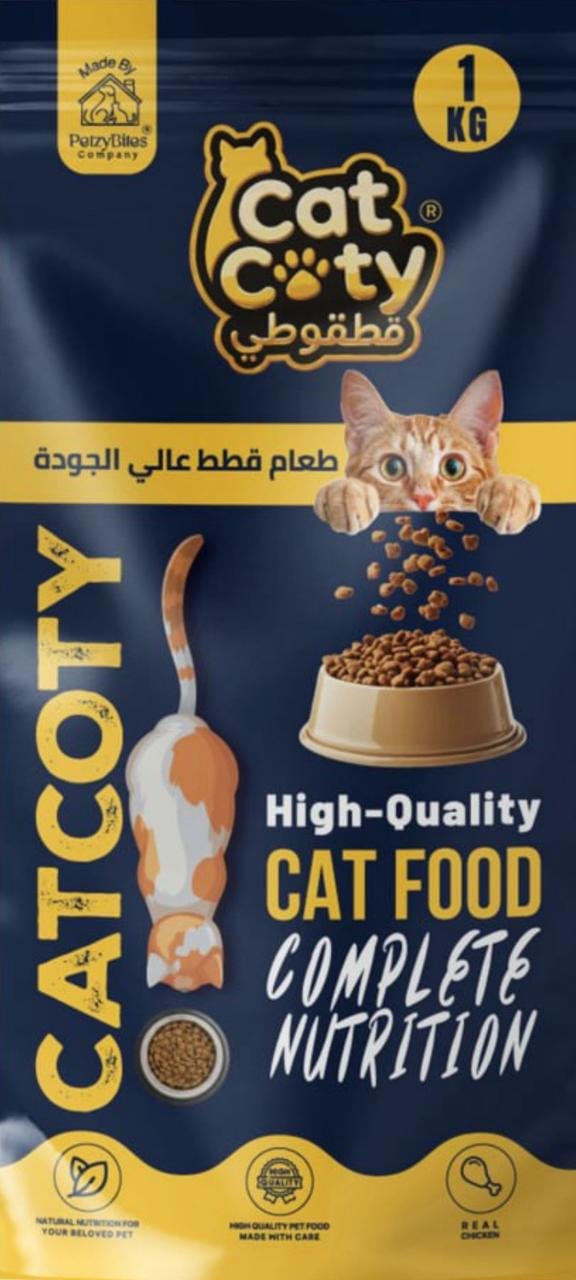
Petzy Bites is an Egyptian factory in the industrial zone in Banha. We produce our own brands for the Egyptian market: CatCoty, Bessa Bites and MshMsh for cats, 101 Bites and Doggo for dogs, with formulas built on international standards and a lot number on every batch.
Where to buy
From our store at 101bite.com, priced in Egyptian pounds with delivery inside Egypt, or from the retail points we serve in Cairo, Giza and the governorates.
Want your own brand manufactured
We manufacture for third parties with a three-ton minimum. Request a quote at our private-label page